

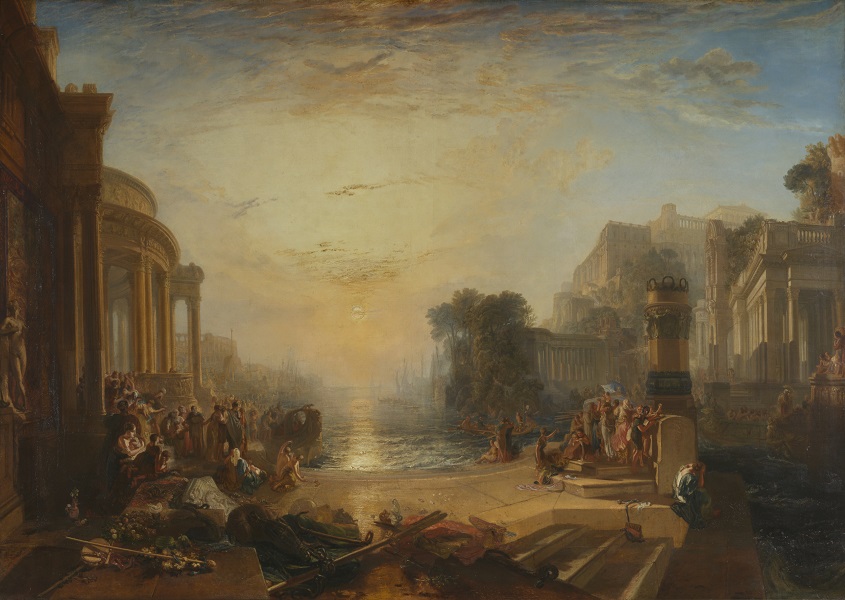
 Tate Britain has announced that, this autumn, it will present the first major exhibition to explore the lives and legacies of JMW Turner (1775–1851) and John Constable (1776–1837), acknowledged as Britain’s most revered landscape artists.
Radically different painters and personalities, each challenged artistic conventions of the time, developing ways of picturing the world which still resonate today.
Coinciding with the 250th anniversary years of their births, Turner and Constable: Rivals and Originals will trace the development of their careers in parallel, revealing the ways they were celebrated, criticised and compared, and how this pushed them to new and original artistic visions.
The exhibition will feature over 170 paintings and works on paper, including Turner’s momentous 1835 The Burning of the Houses of Lords and Commons, lent by Cleveland Museum of Art and not seen in Britain for over a century, and Constable’s The White Horse 1819, recognised as one of the artist’s greatest achievements and last exhibited in London two decades ago.
Born only a year apart – Turner in London’s crowded metropolis and Constable to a prosperous family in the Suffolk village of East Bergholt – the exhibition opens with a consideration of their contrasting early lives. Turner was a commercially minded, fast-rising young star who first exhibited at the Royal Academy in 1790 aged just 15; by contrast, Constable – who was largely self-taught – did not exhibit at the Royal Academy until 1802, focusing instead on perfecting artistic techniques and undertaking sketching tours to create early watercolours.
What they did share, however, was a desire to change landscape painting which at this time had become hugely popular.
The exhibition will explore how both artists developed distinct artistic identities within the competitive world of landscape art, spotlighting their methods, evolution and overlap. Constable built his reputation on the Suffolk landscapes of his childhood, whilst Turner’s paintings reflected his travels across Britain and Europe
By the 1830s, both artists became recognised for taking landscape painting in bold new directions. The stark differences between their work spurred art critics to pit them against one another and to cast them as rivals. In 1831 Constable himself played into this, placing his and Turner’s work side by side at the Royal Academy exhibition. This showing of Turner’s Caligula’s Palace and Bridge next to Constable’s Salisbury Cathedral from the Meadows, prompted a flurry of comparisons.
Almost 200 years later, this exhibition places the artists head-to-head once again and, by bringing together a number of their most distinctive and impressive paintings, it will highlight how Turner and Constable changed the face of landscape painting and elevated it to a genre worthy of grand canvases.
Turner and Constable: Rivals and Originals opens at Tate Britain on 27 November 2025 (until 12 April 2026). For further information: tate.org.uk
Image: JMW Turner, The Decline of the Carthaginian Empire, exh. 1817. Image courtesy of Tate.
Smith Greenfield is an independent insurance broker specialising in insurance for exclusive lifestyles and collectors of valuable objects including: art insurance, antiques insurance, jewellery insurance, watch insurance, vintage car insurance, fine wine insurance and more. To discuss specialist insurance for your lifestyle, please contact our Premier Client Adviser, Imran Moideen: imran.moideen@smithgreenfield.co.uk