

 Opening on 18 October at William Morris Gallery in Walthamstow, Women in Print: 150 Years of Liberty Textiles is a major exhibition highlighting the pivotal role and contributions of women textile designers to the legendary design house.
The exhibition has been conceived in partnership with Liberty Fabrics on the occasion of Liberty’s 150th anniversary, and it shines a light on the evolving influence and status of women in textiles over the past 150 years.
Presenting garments, fabric, original designs, film and historic photographs and featuring designers including Althea McNish, Collier Campbell and Lucienne Day, alongside previously overlooked names, Women in Print celebrates how women have been — and continue to be — at the heart of Liberty’s creative innovations and ongoing relevance today.
Founded in 1875, Liberty began as an importer of textiles and objets d’art from the Middle East and Asia before designing its own fabrics — its floral patterns soon becoming synonymous with British design. The exhibition’s opening section will introduce some of the ways that Liberty has become a household name, from its distinctive ‘Tudorbethan’ storefront, shown in a 1975 design for a scarf by Collier Campbell, to Liberty fabric being used for both high street and bespoke fashion. Highlights include a BIBA trouser suit, a 1978 wedding dress, patchworked in 17 separate Liberty prints, and a contemporary Jalabiya (Mukhawar), featuring a design created by current Liberty Head of Design Polly Mason, embellished in beadwork by UAE-based company Colorful Line.
The second section will show how textiles became established at Liberty. Alongside its links to international design, the design house was also influenced by the British Arts and Crafts Movement of the late 19th century. Drawing inspiration from the natural world and traditionally ‘feminine’ handicrafts, the Movement provided a gateway for women to move from unpaid domestic work to paid design careers. Pioneers like Ann Macbeth, who taught at the Glasgow School of Art, were employed by Liberty. She played a key role in modernising embroidery designs, some of which were later adapted for print. This pivotal transition from stitch to surface design will be explored through rare loans from Liberty’s archive, including early embroidery catalogues and a 1900s pattern book showing how original needlework motifs were transformed into printed textiles.
Growing political, educational and employment opportunities around the time of the First World War opened doors for women to enter professional textile design, and by the 1930s, nearly half of Britain’s textile designers were women. Despite their growing presence, many remained uncredited for their patterns. Women in Print will aim to restore the names of designers to their work, focusing on five designers — Jessie M. King, Lucienne Day, Althea McNish, Mrs Stonely, and Madeleine Lawrence.
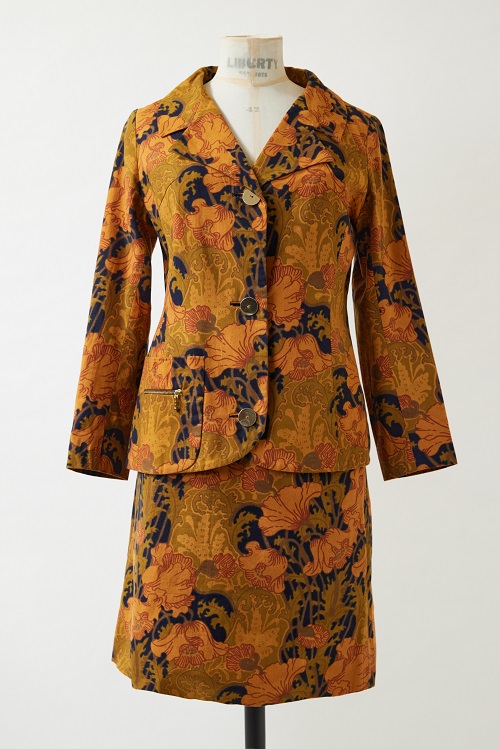
The main gallery will conclude with a display of garments featuring Liberty fabrics, illustrating how the design house’s printed textiles have been incorporated into fashion from the 1930s to today. In response to 1960s developments in taste and design, Liberty embraced nostalgia, eclecticism, and nonconformity — modernising its aesthetic for a younger audience. The brand’s revival during this decade laid the foundation for its continued influence in fashion today. Highlights include a Mary Quant ‘Ginger Group’ floral suit, a ‘Dolly Rockers’ mini dress in psychedelic fabric designed by Pat Albeck, and an outfit from Wales Bonner’s S/S 2025 collection inspired by Trinidadian designer Althea McNish.
In the Gallery’s first-floor galleries, the show will take a close look at the iconic Liberty scarf—an item that has launched the careers of many women designers and remained a staple of the brand from the 19th century to today, and finally the exhibition considers how, across the post-war decades and in response to developments in taste and design, Liberty saw the need to modernise its aesthetic for a younger audience. Highlights here include fabrics created for the Young Liberty range by Colleen Farr and Hilda Durkin and recent collections from 2025 showing Liberty’s transition into the digital age.
Women in Print: 150 Years of Liberty Textiles opens at William Morris Gallery, Walthamstow on 18 October 2025, and continues until 21 June 2026. For further information: wmgallery.org.uk
Image: Printed cotton suit in Liberty fabric, Mary Quant for Ginger Group, c.1965. Credit: Liberty/William Morris Gallery
Smith Greenfield is an independent insurance broker specialising in insurance for exclusive lifestyles and collectors of valuable objects including: art insurance, antiques insurance, jewellery insurance, watch insurance, vintage car insurance, fine wine insurance and more. To discuss specialist insurance for your lifestyle, please contact our Premier Client Adviser, Imran Moideen: imran.moideen@smithgreenfield.co.uk